
How to Celebrate Reformation Day With Kids: Meaningful Ideas for Christian Families
If you've decided that you want October 31 to look a little different in your home this year, you may be wondering:
Okay... but what do we actually do on Reformation Day?
The good news is that celebrating Reformation Day with kids doesn't have to mean giving them a long church-history lecture.
It can be fun.
It can involve crafts, games, special food, costumes, Bible study, coloring, and yes—even candy.
Most importantly, it can give our children an opportunity to understand why the Bible they hold in their hands is such a precious gift and why Christians throughout history were willing to sacrifice so much for biblical truth.
Whether you're planning a quiet evening at home, adding Reformation Day to your homeschool lessons, teaching a church group, or hosting an entire Reformation Day party, here are some meaningful ways to celebrate October 31 with your children.
1. Start With the Story of the Reformation
Before the crafts and games, give your children a little context.
You don't have to explain the entire Protestant Reformation in one sitting. For younger children especially, keep the story simple.
Explain that more than 500 years ago, many ordinary people didn't have Bibles they could read for themselves.
Books were expensive. Bibles were not readily available in people's homes the way they are today, and church services were commonly conducted in Latin.
During this period, serious problems and abuses had developed within the church.
Then introduce people such as Martin Luther, John Wycliffe, Jan Hus, and William Tyndale.
Explain that on October 31, 1517, Martin Luther famously posted his 95 Theses, challenging abuses surrounding indulgences and beginning a controversy that would help ignite the Protestant Reformation.
For younger children, you can boil the lesson down to something they can remember:
God's Word matters.
We should know what the Bible says.
Salvation cannot be bought or earned.
Jesus is enough.
That's already a wonderful foundation.
2. Teach Your Children the Five Solas
One of my favorite ways to introduce children to the Reformation is through the Five Solas.
They give children five simple truths that summarize important teachings emphasized during the Protestant Reformation:
Sola Scriptura — Scripture Alone
The Bible is our ultimate authority for what we believe.
Sola Gratia — Grace Alone
Salvation is a gift of God's grace.
Sola Fide — Faith Alone
We are justified through faith, not because we have earned salvation through our good works.
Solus Christus — Christ Alone
Jesus Christ is our only Savior and mediator.
Soli Deo Gloria — To the Glory of God Alone
Ultimately, all glory belongs to God.
Instead of simply asking children to memorize these Latin phrases, turn them into something they can interact with.
This is why I created our Five Solas Coloring Wheel.
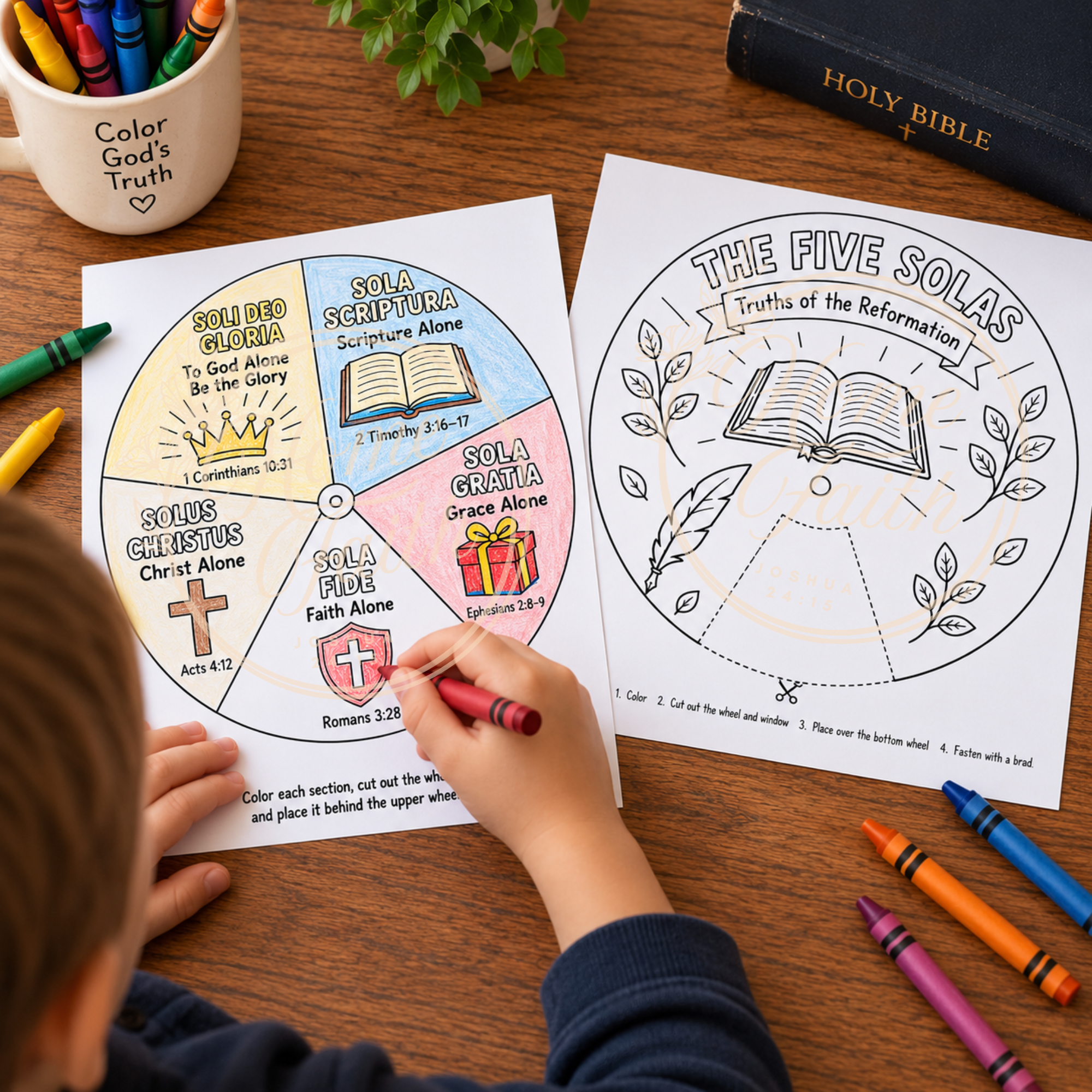
Children color and assemble the paper wheel, then rotate it to reveal each Sola, its meaning, a symbol, and Scripture.
It's simple enough to use at home but also works beautifully for homeschool groups, Christian classrooms, children's ministry, or a Reformation Day party.
And while their hands are busy coloring and assembling, you have a natural opportunity to talk about what each truth means.
That's the kind of learning I love—hands busy, Bible open, conversation happening.
3. Make Reformation Day Coloring Bookmarks
Here's another very simple activity, especially if you don't want to prepare an elaborate craft.
Let your children color their own Reformation-inspired wooden bookmarks.
You can use imagery connected to Reformation history, such as:
Sola Scriptura with an open Bible
Here I Stand with a quill
The 95 Theses with a church door
A printing press
A candle representing the light of God's Word
As they color, talk about what each image represents.
For example, if your child chooses the printing press bookmark, explain how the printing press helped ideas and writings spread much more rapidly during the Reformation era.
If they choose the Bible, talk about the privilege of having God's Word readily available in our own language.
And when they're finished, they have something they can actually use in their Bible.
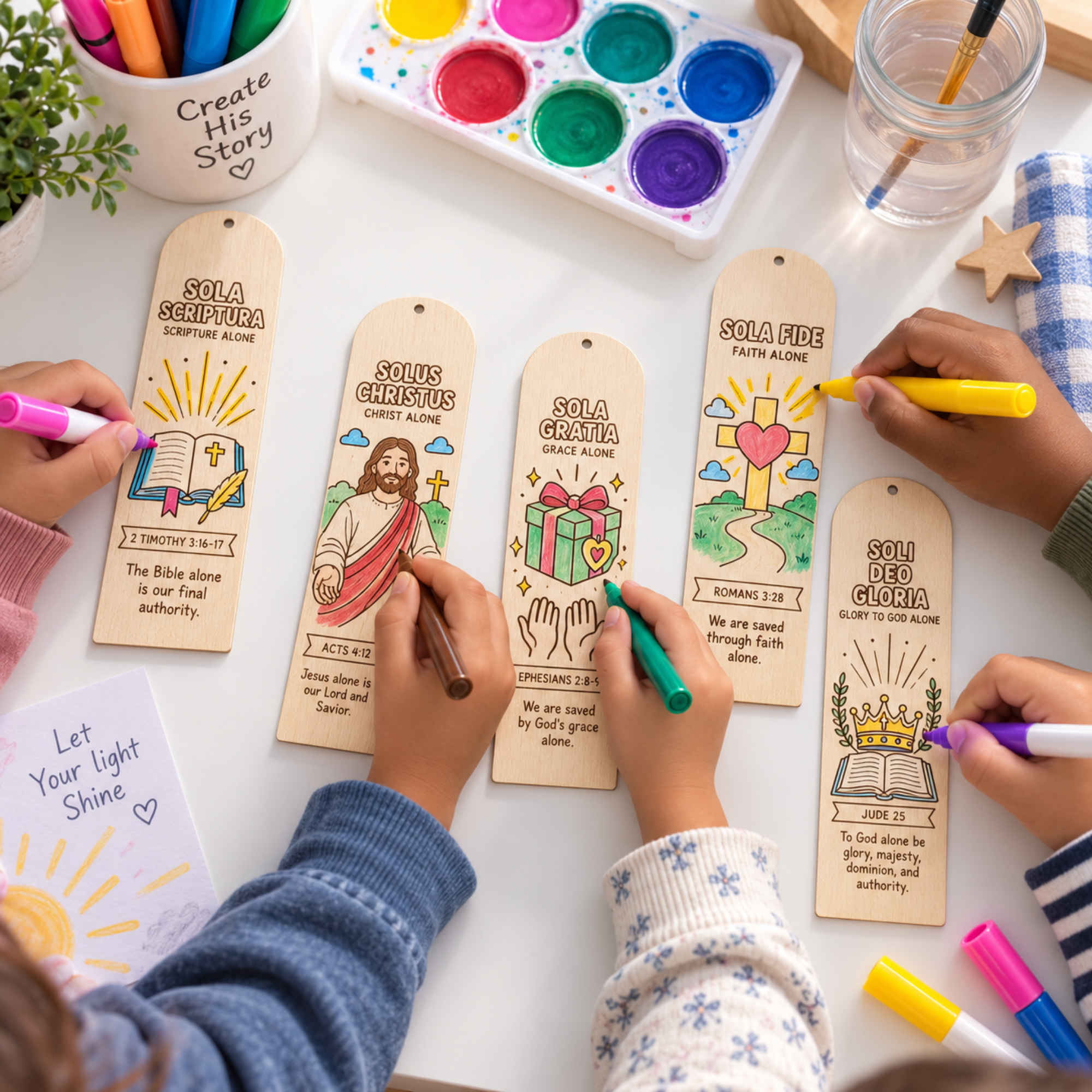
This would also make a sweet Reformation Day party favor if you're celebrating with other families.
4. Learn About Martin Luther at the Diet of Worms
Kids usually remember history better when there is a story attached to it.
One of the most memorable moments to teach is Martin Luther's appearance before the Diet of Worms in 1521.
Despite the funny-sounding name—which children will absolutely notice—the Diet of Worms wasn't about eating worms!
A diet was an assembly, and Worms was the German city where it took place.
Luther was called to answer for his writings and was asked whether he would retract them.
Teach your children about the courage it took to stand before powerful authorities while believing that his conscience had to remain bound to God's Word.
This gives you a wonderful opportunity to ask:
Would I stand for what Scripture says even if everyone around me disagreed?
That's a question worth discussing with our children.
5. Try a “Translate the Bible” Activity
One of the most important parts of Reformation history for children to understand is just how precious access to Scripture is.
Today, many of us have several Bibles sitting around our homes.
Our children can open one whenever they want.
It's easy to take that for granted.
Teach them about the work of Bible translators and the sacrifices involved in making Scripture available to ordinary people in languages they could understand.
Then make the lesson interactive.
Give children a short Bible verse written with a simple symbol code and let them “translate” it using a decoding key.
Once they've decoded the verse, read it together from the Bible.
It's a fun activity, but it leads naturally into a much bigger conversation:
What would it be like if we couldn't read the Bible for ourselves?
6. Turn Reformation Day Into a Homeschool History Lesson
If you homeschool, October 31 can easily become a special history and Bible lesson.
And you don't need to abandon your entire school day to do it.
You could create a simple Reformation unit that includes:
History: Learn who Martin Luther was and what happened in 1517.
Timeline: Put major Reformation events in chronological order.
Geography: Find Germany and other important European locations on a map.
Vocabulary: Learn words such as Reformation, indulgence, reformer, doctrine, and printing press.
Bible: Study Scriptures connected to the Five Solas.
Copywork: Choose a short Bible verse about Scripture, grace, faith, or standing firm.
Art: Color a picture of Martin Luther, design a Reformation bookmark, or complete the Five Solas wheel.
Writing: Ask older children to explain one of the Five Solas in their own words.
I've also put together Reformation homeschool resources around these ideas because I wanted something that combined actual history with biblical application, rather than making October 31 simply another themed craft day.
You can do the whole lesson or choose two or three activities depending on your children's ages.
7. Read Psalm 46 Together
You can't talk about Martin Luther for very long without eventually coming across “A Mighty Fortress Is Our God.”
The hymn is closely associated with Luther and draws heavily from the imagery of Psalm 46.
So open your Bible together and read Psalm 46.
Pay particular attention to the opening:
“God is our refuge and strength, a very present help in trouble.” — Psalm 46:1
Ask your children:
What is a fortress?
Why would someone run to a fortress?
What does it mean for God to be our refuge?
Then draw or build a fortress.
Little children could make one with blocks or cardboard boxes. Older children could illustrate Psalm 46 in a Bible journal or notebook.
You could even play or sing A Mighty Fortress Is Our God afterward.
Suddenly, church history, Scripture, music, and play are all connected.
8. Have a Reformation Day Bible Journaling Session
Reformation Day activities aren't only for little kids.
If you have older children or teenagers—or if Mom wants to participate too—turn part of the evening into Bible journaling time.
Choose Scriptures connected with the Five Solas and study them together.
You might read passages about:
The authority and usefulness of Scripture
Salvation by grace
Justification through faith
Christ as our mediator and Savior
Living for God's glory
Then let everyone journal, take notes, add stickers, create Scripture cards, or decorate their Bible margins.
Our Five Solas Bible Journaling Kit was designed for exactly this kind of slower, Scripture-centered Reformation study.
It includes Five Solas study materials and journaling elements that can be used while working through the biblical truths behind the Reformation.
This can be especially meaningful for families with older children who have outgrown simple coloring crafts but still enjoy creating while they study.
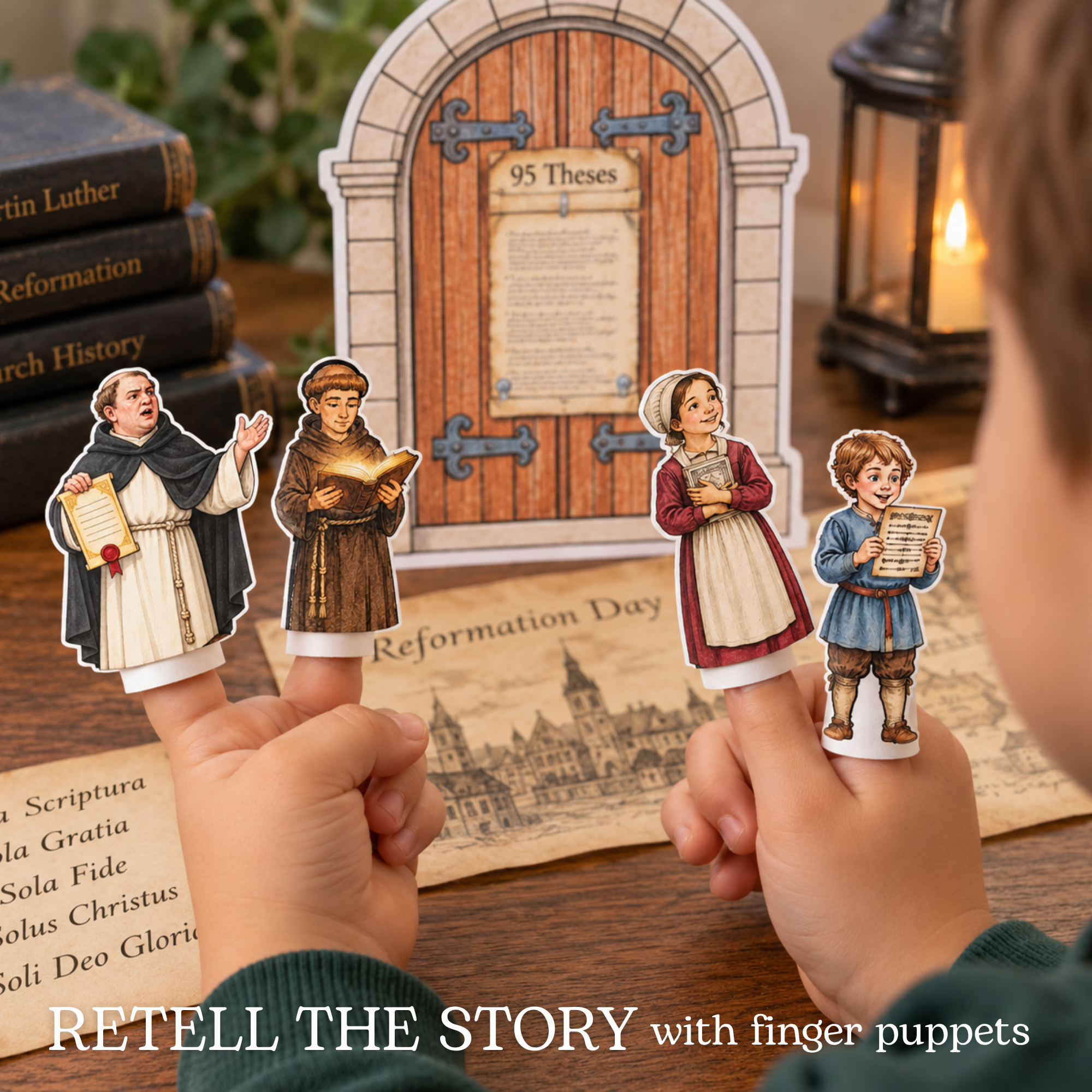
9. Dress Up as People From Reformation History
If your children love costumes, you don't necessarily have to remove dressing up from October 31.
Just give it a different purpose.
Let them dress as:
Martin Luther
Katharina von Bora
William Tyndale
John Wycliffe
Jan Hus
Johannes Gutenberg
A sixteenth-century printer
A scholar
A Bible translator
A Reformation-era family
You don't need expensive historical costumes either.
A robe, cape, hat, old book, quill, apron, or simple homemade props can go a long way.
Then have each child tell everyone who they are and one thing that person did.
Now the costume isn't just a costume.
It tells a story.
10. Set Up Reformation Day Activity Stations
If you're hosting several families or planning something for your church, activity stations make the celebration much easier.
Instead of trying to entertain 20 or 30 children with one activity at the same time, let them rotate through different parts of Reformation history.
You could have stations for:
The 95 Theses — Children learn what happened on October 31, 1517.
The Printing Press — Learn how printed materials helped ideas spread.
Translate the Bible — Complete a Scripture decoding activity.
The Five Solas — Make the Five Solas coloring wheel.
Here I Stand — Learn about the Diet of Worms and standing firm on God's Word.
A Mighty Fortress — Read Psalm 46 and complete a fortress activity.
You can add games, snacks, crafts, and Bible activities to each station.
I've been working on a complete Reformation Day party setup built around this idea because it works especially well for churches, homeschool groups, co-ops, and families celebrating together.
It turns church history into something children can walk through rather than simply listen to.
11. Don't Forget the Food
Please feed the children.
Church history is much more exciting when snacks are involved.
You can make this as historically inspired—or completely unserious—as you want.
Try pretzels, bread and cheese, apple cider, German-inspired foods, simple baked treats, or foods your own family already loves.
You could also label ordinary foods with fun Reformation-themed names.
And yes, you can absolutely have candy.
Choosing Reformation Day instead of Halloween doesn't mean October 31 needs to become the annual evening when Christian children watch everyone else eat chocolate.
Make it special.
12. Create a Reformation Day Treasure Hunt
Hide clues around your house, church, or yard.
Each clue can lead children to another important Reformation symbol:
A Bible.
A quill.
A scroll.
A hammer.
A church door.
A printing press picture.
A candle.
A fortress.
At each stop, include a tiny piece of history or a Bible verse.
The final clue could lead to a treasure box filled with candy, bookmarks, stickers, or other small prizes.
For younger children, keep the clues visual.
For older children, make them solve Scripture references or historical riddles.
13. End the Day Around the Bible
After all the activities, crafts, food, costumes, and games, bring everyone back to the reason you celebrated in the first place.
Open the Bible.
You could read Psalm 46, Romans 3, Ephesians 2:8–9, 2 Timothy 3:16–17, or another passage you've studied throughout the day.
Then ask your children one simple question:
“Why should we be thankful that we have God's Word?”
Let them answer.
You might be surprised by what they remember.
Finish by praying together and thanking God for His Word, for salvation through Christ, and for Christians throughout history who faithfully preserved, translated, taught, and proclaimed biblical truth.
Keep Your First Reformation Day Simple
If this is your family's first year celebrating Reformation Day, please don't feel like you need to do everything on this list.
You don't.
Choose one lesson, one activity, one special food, and one family tradition.
That's plenty.
For example:
Read the story of Martin Luther and the 95 Theses.
Make a Five Solas coloring wheel.
Eat a special dessert.
Finish the evening by reading Psalm 46 together.
Done.
Next year, maybe you add costumes.
The following year, invite another family.
Eventually, October 31 can become something your children anticipate because this is simply what your family does.
And that is how family traditions are built.
Ready to Start Your Own Reformation Day Tradition?
If you're reading all of these ideas and thinking, “I love this... but I don't know where to start,” I made something especially for you.
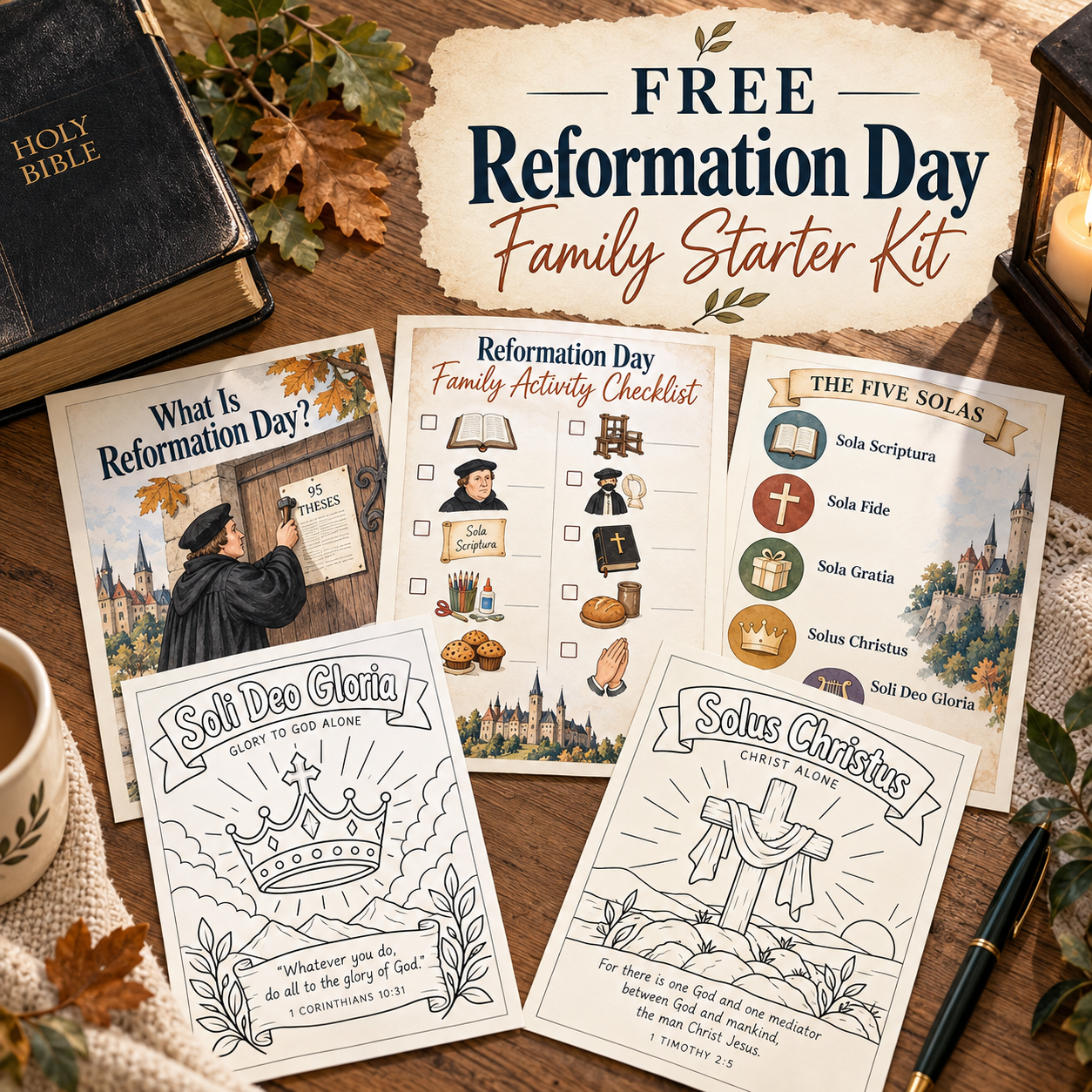
Our FREE Reformation Day Family Starter Kit was created to help families begin celebrating Reformation Day without making it complicated or overwhelming.
It's a simple way to gather your family, open God's Word, learn why the Reformation matters, and begin creating meaningful October 31 traditions together.
Download here the→ FREE Reformation Day Family Starter Kit
And if you're ready to do a little more, you can explore the rest of our Reformation Day resources in the Home Faith shop.
You'll find hands-on resources for different ages and ways of celebrating, including our Five Solas Coloring Wheel, wooden coloring bookmarks, Bible journaling resources, homeschool activities, and Reformation Day party ideas—all created to help make learning about biblical truth and church history meaningful and memorable for your family.
Explore all Reformation Day resources → [HOMEFAITH.STORE]
Come Celebrate With Us
And you don't have to wait until October 31 to join us.
Over on our social media, we're sharing the behind-the-scenes process of preparing for Reformation Day, new resources we're creating, Bible journaling, crafts and activities for kids, Reformation history, ideas for celebrating at home and church, and glimpses of how we're making these traditions part of our own family life.
Come follow along, save the ideas you want to try, and celebrate with us.
Instagram → [INSTAGRAM]
Pinterest → [PINTEREST]
YouTube → [YOUTUBE]
Make October 31 Something Worth Remembering
Reformation Day doesn't have to feel like the consolation prize because your children aren't celebrating Halloween.
That's not the goal.
We're not trying to create a second-rate alternative.
We're creating an entirely different tradition.
One filled with laughter, crafts, good food, Scripture, history, family, and conversations about people who believed God's Word was worth standing for.
Our children can learn that Sola Scriptura isn't simply a Latin phrase printed on a worksheet.
God's Word is precious.
Grace is a gift.
Faith matters.
Christ is enough.
God deserves the glory.
And those are truths worth celebrating.
So whether your Reformation Day consists of one coloring page around the kitchen table or a church-wide celebration with activity stations, don't worry about making it perfect.
Open the Bible. Tell the story. Make it joyful.
And give your children a reason to look forward to October 31 for something entirely different.
Whether you use one printable around your kitchen table or plan an entire Reformation Day celebration, my hope is that these resources make it a little easier to create an October 31 that your children will remember.
Not because everything was perfect.
Not because you did every activity.
But because they learned that God's Word is precious, salvation is by grace through faith, Christ is enough, and God alone deserves the glory.
Let's make October 31 a day worth remembering.
Soli Deo Gloria.
With faith,
Marleigh
Christian wife, mom, and creator behind Home Faith, where I create simple, meaningful resources to help families grow in God's Word and live out their faith in everyday life.
